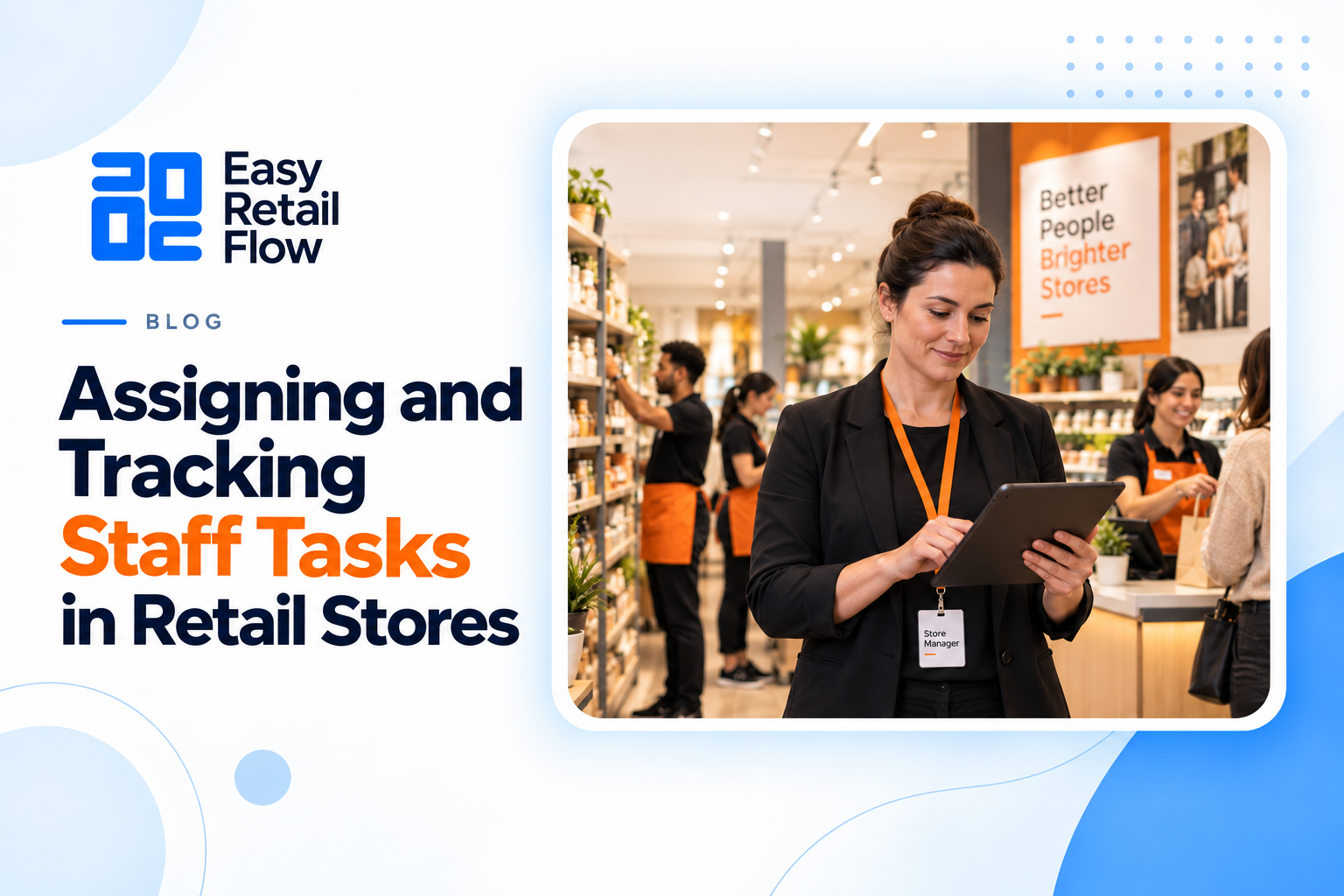
A retail store can have excellent products, reliable stock, and a steady stream of customers, and still run poorly if the team inside it doesn’t know who is responsible for what. Task ambiguity is one of the most common and least visible sources of operational friction in retail. Things get missed, duplicated, or delayed not because staff are unwilling but because the assignment and follow-through were never clear to begin with. We built Easy Retail Flow’s Employee and Task Management tools with exactly this operational reality in mind. This is what effective task assignment and tracking actually looks like in a retail environment.
Why Verbal Task Assignment Breaks Down at Scale
In a small store with two staff members, a verbal briefing at the start of the shift mostly works. Each person knows their space, their responsibilities are few, and the manager can see what is happening at any point.
That model stops scaling almost immediately. Add a third employee, a second shift, or a second location, and the gaps appear fast. Verbal instructions don’t transfer reliably between shifts. Tasks assigned in passing get forgotten when the floor gets busy. When there’s no record of what was assigned or whether it was completed, the only way to check is to ask, and asking takes time that the floor rarely has.
Structured task assignment creates a record. That record is what makes accountability possible without constant supervision.
What Effective Task Assignment Looks Like in Practice
Getting task assignment right in a retail context means more than writing a to-do list. It means each staff member, at any point in their shift, knows exactly what they are responsible for, what priority it carries, and what completed looks like.
Tasks should be assigned to named individuals, not to shifts or groups, so responsibility is unambiguous
Priority levels should be visible so staff can sequence their work without needing to interrupt a manager
Deadlines or shift-based timeframes make it clear when tasks need to be done, not just that they need to be done
Task descriptions should be specific enough that a staff member new to the role can execute without guessing
Completion status should be updated by the assigned person, creating a record of accountability rather than relying on manager observation
managing retail staff through a system that connects task assignment with team accountability and store-level oversight means the manager’s role shifts from checking whether things were done to reviewing whether they were done well.
Tracking Completion Without Micromanaging
The goal of task tracking is not surveillance. It is visibility.
A manager who can see, at a glance, which tasks are complete, which are in progress, and which haven’t been started yet doesn’t need to walk the floor asking questions every hour. That visibility is especially valuable in busy periods when the manager’s attention is split across multiple demands at once.
When task tracking is built into the same system as staff profiles and store operations, completion data accumulates over time. Patterns become visible. Certain task types are consistently completed early, or consistently deprioritized. Certain team members consistently finish ahead of schedule while others need more support. That data is the foundation of meaningful performance conversations, not as a disciplinary tool, but as a management one.
Managing Tasks Across Multiple Outlets
For retailers operating more than one store, task management becomes structurally more complex.
Each outlet has its own operational rhythm, its own staff, and its own daily task load. Without a centralized view, a manager overseeing multiple branches is relying on individual check-ins or separate records for each location, neither of which gives a coherent picture.
Assign and monitor tasks across multiple store locations from a single dashboard
Track completion status per outlet without switching between separate tools or systems
Identify which stores are consistently on schedule and which may need operational support
Keep staff accountability consistent regardless of location, so standards don’t vary between branches
how staff roles and access levels are structured across a multi-store environment determines how effectively task oversight can be maintained without giving every employee the same level of system access. The structure of the team and the structure of the system need to align.
When Tasks Connect to the Larger Operation
Staff tasks in retail don’t exist in isolation. A stock check connects to inventory levels. A shelf restock connects to what was sold. A customer follow-up connects to a recent transaction. When task management sits within the same platform as inventory, sales, and store operations, that context is available without switching tools.
A team member completing a low-stock check is working from the same data that the inventory system is tracking in real time. A task assigned around a specific product category can be informed by current sales performance rather than guesswork.
building retail staff management into the same system as inventory, POS, and reporting means tasks are grounded in operational data rather than generated separately from it.
Easy Retail Flow’s Employee and Task Management feature keeps staff organized, tasks assigned, and completion tracked across one store or several, all from a centralized dashboard that makes oversight simple without making it heavy.
Easy Retail Flow’s Employee and Task Management tools allow retailers to assign tasks to named staff, track completion across locations, manage employee profiles and roles, and monitor team activity from a single platform.